

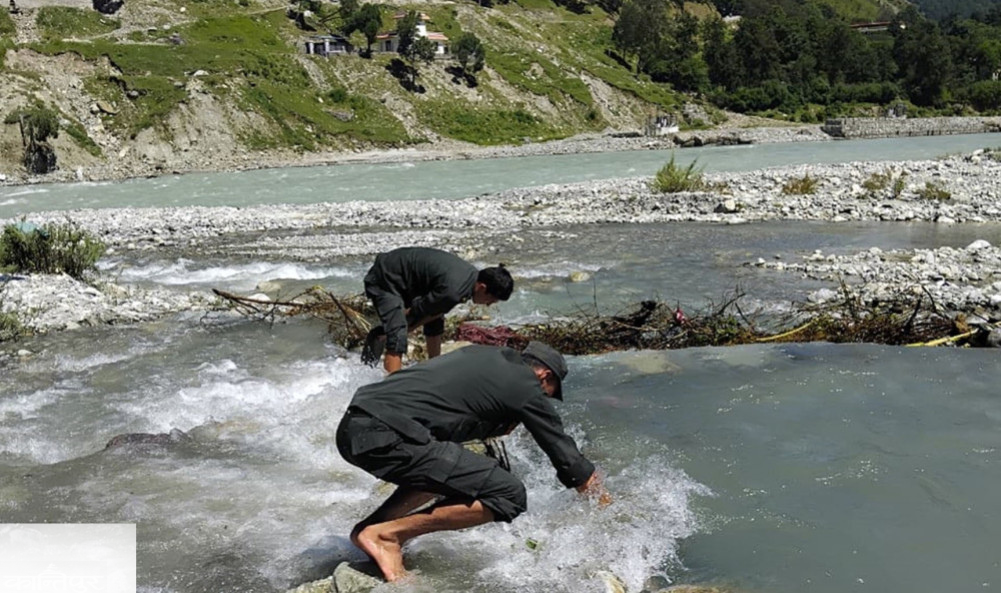
Recently, the Jayaprithvi municipality removed the “Tip” nets, the fine bamboo traps that had been laid across the Seti river and other streams to catch fish during their most vulnerable time, during the months of Bhadra and Asoj. These are not just any months; they are the sacred season when fish lay their eggs, when life begins again beneath the ripples.
Ignoring the municipal restriction, some locals had continued to set traps along the Dungrigad and Bahuliaad streams. But led by the municipal police chief Rajendra Khadka, officers waded into the waters, pulling out the nets one by one. “We first warned and made them understand,” Khadka said. “But if anyone repeats this act, legal action will follow.”
Experts say that during the rainy season, when the big rivers turn muddy and fierce, fish seek shelters in small streams, only to return to the main river around Bhadra and Asoj. Yet, it is in this very moment of return that many people divert the water flow and lay traps, barring the fish from completing their ancient journey.
Mayor Chet Raj Bajal said, “These months are the time not only for breeding, but also for the fish to return home from the small streams to the Seti. When we block their way, we are not just catching fish — we are silencing a species.”
He emphasis that the municipality’s ban is not merely a restriction, but a gesture of renewal. “If we stop fishing only during breeding season,” he said, “the number will rise again. When fish thrive, the river’s ecology thrives, and so do the people who depend on it for their livelihood.”
The spirit of protection has now spread across Bajhang. Not only Jayaprithvi, but also Talkot, Thalara, Kedarsyun, and Chhabispathibhera rural municipalities have imposed a four-month fishing ban along the Seti River and its tributaries, during Bhadra, Asoj, Fagun, and Chaitra, the seasons when fish lay eggs, reproduce, and migrate.
Under the Aquatic Life and Biodiversity Protection Act, 2076, the municipalities have issued strict orders, violators will face legal consequences.
The municipalities’ findings are alarming. Over the years, fishermen have caught pregnant fish, killing future generations before they could even begin. Studies show that a single Asala fish weighing one kilo can lay over 14,250 eggs at once. The loss of even a few such fish ripples through generations — until silence takes over where life once swam.
Today, the Seti River carries that silence in its current form. Studies reveal that in just fifteen years, the number of fish species in the river has dropped by more than 70 percent.
This story was originally published in the national newspaper in September 2024.