

After five years of enactment of the ‘Aquatic Animal and Biodiversity Conservation Act in 2020 (AABCA) by five local governments (LGs) of Bajhang district, they have started the implementation of the AABCA that they had prepared and enacted with technical support of USAID-Paani Project in March 2020. It is really taken as a milestone in the history of Bajhang District.
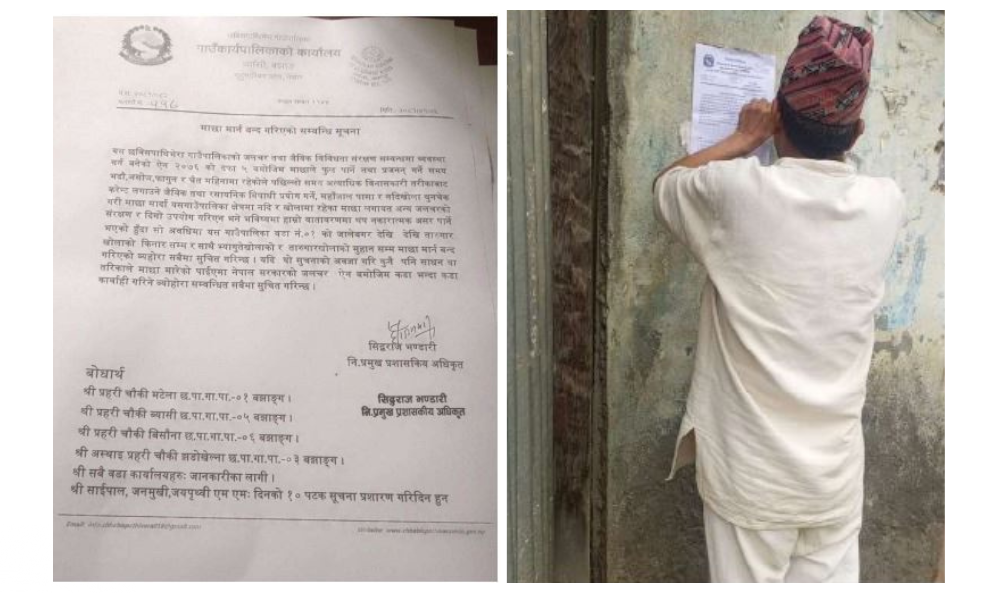
On the outset of implementation of the AABCA, Talkot, Thalara, Kedarsyun, and Chhabispathibhera Rural Municipality (RM) and Jayaprithvi Municipality have imposed moratorium on fishing along/across Seti River and its tributaries for four months – August 17 – October 16 and February 13 – April 13 (Bhadra, Ashwin, Phalgun and Chaitra) every year. For this exemplary task and to ensure that people are informed about the prohibition on fishing, the five LGs have been broadcasting notice every day five times in different FM radios and issued letters to different agencies and including Police to enforce moratorium effectively. This is probably the first time that the LGs have jointly prohibited fishing at watershed levels.
USAID Biodiversity (Jal Jangal) APS grant partner Social Development Centre Nepal (SDC Nepal) a Bajhang based NGO, played a catalytic role which resulted into the issuance of the moratorium during spawning season. SDC Nepal organized sensitization programs for the elected representatives, staffs and other stakeholders on scope, status, opportunities and challenges of aquatic biodiversity with respect to the west Seti watershed and the provisions of the AABCA to make them aware of the provisions of the AABC Act that they enacted five years ago and to encourage them to implement the different provisions of the Act. Besides, SDC Nepal formed the Aquatic Biodiversity Management Committees in the five LGs and oriented them.
After participation in series of sensitization activities conducted by SDC Nepal under the APS grant, LGs’ representatives and staff started showing concern about the declining fish stock and loss of aquatic biodiversity. The notice issued by Jayaprithvi Municipality states, “over the last few years, people have been fishing illegally by using poison, very small mesh size fishing nets, divert the river channel/flow, use electric current etc.; as a result, there is huge decline of fish stock in West Seti River and its tributaries in the West Seti Watershed. The notice also states that the Municipality herby prohibits any kind of fishing along/across the Seti River and its tributaries within the municipal areas as per the AABCA, 2076 during these four months August 17 – October 16 and February 13 –April 13 so that they could balance the aquatic eco-system and contribute for saving the life of aquatic animals. It also states that in case of non-compliance with the notice, the illegal fishers will be punished as per the provisions of law.
Similarly, Chhabispathibhera Rural Municipality has also issued same kind of notice which mentions that they are worried about the decline in fish stock because of destructive fishing during their spawning season, Siddha Raj Bhandari, Acting Chief Administrative Officer reported. He also says that around 80% fish population has declined in the nearby river of the rural municipality’s area over the years. If they are able to control the illegal fishing during these four months, they can ensure the life of the unlimited numbers of fishes. Accordingly, they prohibited the illegal fishing”, Bhandari Said.
Kedarsiyun Rural Municipality has also released same kind of notice to save the aquatic animals and biodiversity. Mr. Ganesh Bohara, Chairperson of Kedarsiyun said, “Since the number, size and varieties of fishes have been decreasing in the West Seti Watershed over the years, they are compelled to rethink and prohibit illegal fishing practices.” He added, “Deura is the area of Kedarsyun RM where we used to catch a single fish weighing around 30/40 Kg’s in the Seti River, however, it is like a dream nowadays. It is even difficult to catch fishes weighing one to two Kg’s as well. Therefore, to revive the fish stock both abundance and size, we discuss and decide to implement the law all over the RM.” For sensitizing them, he thanked USAID Biodiversity (Jal Jangal) Project on behalf of the RM.
Dhan Raj Kami, a resident of Jayaprithvi Municipality, reported that Satto fish (Mahseer) which even weighs up to 65 Kgs has also disappeared from Seti River over many years. Nearly 40 years before, he used to catch such fishes, but nowadays, neither he heard about it nor witnessed himself.
According to him, Satto fish is considered as medicine for Malayria and diseases that originate from extreme heat. Some people are protesting against the moratorium on fishing in the spawning season through social media expressing that the LGs started to oppose their fishing rights which they have been utilizing over many years. However, majority of people have fully supported the prohibition on fishing since it is sustaining the aquatic ecosystem. This conservation campaign and movement was firstly initiated by Jayaprithvi Municipality by mediating urgent notice through Radios and social media on 8 August 2024. People expressed their vent a lot on Jayaprithvi Municipality as it was the lone crusader first. Later, other four LG also issued their moratorium notices, one after another, in a collaborative and competitive ways. As a result, the voices opposed through social media have been minimized continuously.
Yuvraj Bhandari, District Superintendent of Police and Chief of District Police Office, Bajhang, stated that the police have also been informed to assist in the implementation of the municipalities’ decision to ban fishing for two months and that they will provide all possible support.
“The municipalities’ decision to conserve aquatic biological diversity is a good one,” said Bhandari, “We will fully support its implementation. If anyone is found fishing during this period, the police will catch them and hand them over to the respective LG.”
Nowadays, five different FMs of Bajhang district Saipal FM, Jayaprithvi FM, Bajhang FM, Thalara FM and Kedar FM have been disseminating the notices on prohibition on fishing continuously. All the five LGs said that they would continue to prohibit and broadcast such notices from August 17 – October 16 and February 13 – April 13 every year. It is obvious from this initiative that all the five LGs are likely to retain this conservation campaign and movement for the conservation and reviving of fish population and aquatic life gradually over the next couple of years. SDC Nepal’s CEO Basant Pratap Sing is optimistic that other LGs will also follow suit in the West Seti Watershed and other watersheds in different part of the country to provide new lease of life to fish and other aquatic animals.