

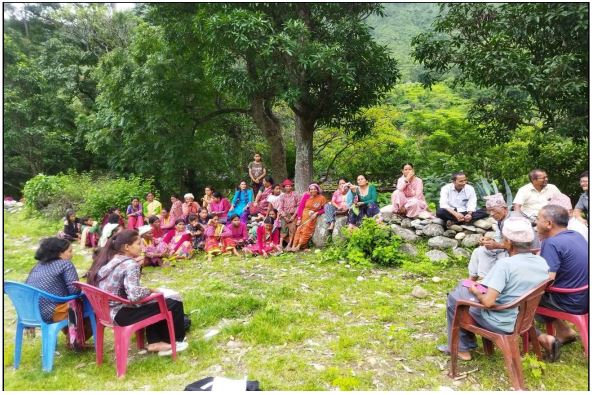
SDC Nepal conducted one day training in six rural municipalities-Talkot RM, Chhabispathivera RM, Kedarsiun RM, Khabtadchhanna RM, Thalara RM and Masta RM to Strengthen Municipal Level Forest, Environment and Disaster Management Committee. This training is grounded in the principle of Sustainable Development Goal 13 (SDG 13, Climate Change), aimed to educate and empower representatives of Local Government and LG officials to understand and tackle the impacts of climate change.
The training provided a detailed overview of what climate change is, its causes and its impacts. Participants were educated on SDG 13, which calls for urgent action to combat climate change and its impacts. Participants were sensitized to different types of disasters induced by Climate Change, including floods, landslides, and extreme weather events. Rural Communities are often most vulnerable to the impacts of climate change, yet they have the least resources to mitigate these effects. The training highlighted the specific impacts of climate change on their communities.
They have faced increasing incidents of climate induced disasters like floods, landslides, drought, pest and disease in agriculture crops, drying up water sources, outburst of diseases etc. which threatened their livelihood. The most significant outcome of the training was the realization that combating climate change required awareness and action-specifically the allocation of resources. The participants, many of whom were Local Government Representatives, recognized the critical need to allocate budget to address climate change impacts.
A dedicated budget allows for the development and implementation of early warning systems, disaster response plans, infrastructure improvements and community awareness programs. These measures help prevent and reduce the impact of disasters before they occur, saving lives and minimizing damage. Also, in the event of a disaster, a preallocated budget ensures that emergency services, medical aid, food, water and shelter can be provided quickly. Without resources to manage and recover from disasters, communities can experience long-term disruptions, leading to social unrest and economic decline.
Following the training, these municipalities took bold steps to integrate climate change into their budgeting, planning and implementation. Besides that, Seti River, which used to have a wide variety of fish species, has experienced a significant drop in its fish population over the years. Various factors such as poisoning, electrical fishing, extensive net usage, and excessive fishing during breeding season had impacted the decline of aquatic life.
In response to the need for prompt action, rural municipalities have allocated budgets to implement the Aquatic Animal and Biodiversity Conservation Act (AABCA) and for executing a conservation program. 37 Six Rural Municipalities had allocated budgets for disaster management and for Aquatic Animal and Biodiversity Conservation Programs.
Talkot Rural Municipality had allocated NPR 1,305,000 for Disaster Management, NPR 160,000for Environment Protection and Climate Change adaptation Program and NPR 200,000 for Jal Jangal Conservation. Kedarsiun Rural Municipality had allocated NPR 6,000,000 for Forest, Environment and Disaster Management, NPR 200,000 for waste management and NRP 300,000 for Aquatic Animal and Biodiversity Conservation program. Khabtadchhanna Rural Municipality had allocated NPR 6,222,000 for disaster management, NPR 100,000 for forest and soil conservation and NPR 100,000 for Aquatic Animal and Biodiversity Conservation Act formation and implementation of conservation related programs.
Chhabispathivera Rural Municipality had allocated NPR 3,200,000 and NPR 80,000 for Aquatic Animal and Biodiversity Conservation Program. Remaining two municipalities; Masta Rural Municipality and Thalara Rual Municipality had also allocated a budget but not mentioned as their Redbook was not published yet.